9+ Plumbing Tips for New Homeowners in Queen Creek
You just closed on a house. Before the last box comes off the truck, take twenty minutes and walk your plumbing system start to finish. Queen Creek throws a few curveballs at new owners that nobody warns you about until a pipe fails or a water bill doubles.

Quick Answer: Essential Plumbing Tips for New Homeowners
Find your main shut-off valve the day you get the keys. Book a full inspection sometime in that first month. Look at the water heater’s age, run every faucet and toilet once, and keep an eye on your pressure. Between the hard water and the slab foundations common here, small problems in Queen Creek turn expensive fast if nobody catches them early.
| Task | Why It Matters | When to Do It |
| Locate the main shut off valve | Cuts water fast during an emergency | Day one |
| Inspect for visible leaks | Catches existing damage early | Day one |
| Test every faucet and toilet | Confirms fixtures work properly | Day one |
| Check the water heater | Reveals age and maintenance needs | Week one |
| Book a professional inspection | Finds hidden problems before they grow | Month one |
| Test or install a water softener | Cuts hard water scale buildup | Month one |
| Flush the water heater | Removes sediment, improves efficiency | Every year |
Want a second set of eyes on your new place? Schedule your plumbing inspection with PlumberinQueenCreekAZ and get a written price before anyone touches a wrench.
Why Queen Creek Plumbing Is Different From Other Cities
Move here from almost anywhere else, and your plumbing behaves a little differently. Blame the water and the ground underneath the house.
The water here runs hard. The Water Quality Association draws the line at 7.0 grains per gallon for hard water and 10.5 for very hard. Groundwater across the East Valley usually lands on the very hard side of that scale, since it moves through mineral-heavy desert rock on its way to your tap. [NEEDS A REAL NUMBER: current grains per gallon reading for Queen Creek from the local water provider]. That mineral load coats the inside of pipes, tanks, and fixtures at a pace most transplants have never dealt with.
Slab foundations hide your plumbing. Most homes in this area sit on a concrete slab, which means the main water and drain lines run beneath it instead of through an open basement or crawl space. A leak down there can run for weeks before anyone notices, and by then you’re looking at real structural repair, not just a plumbing fix.
The heat works against your pipes too. Triple-digit summers push pipe materials to expand and put extra strain on irrigation lines, hose bibs, and anything sitting outside.
Key takeaway: hard water, slab construction, and desert heat stack together here in a way that makes East Valley plumbing maintenance look nothing like what you may have learned in a different climate.
8 Things to Check in Your First 24 Hours
Get through this list before your first night sleeping in the house.
1. Find the main shut-off valve and make sure it actually turns off.
2. Locate the shut-off valve under every sink and behind every toilet.
3. Look under each sink and around each toilet base for leaks.
4. Run every faucet and check for steady flow and normal temperature.
5. Flush each toilet and watch how it refills
6. Turn on every shower and watch how fast the drain clears.
7. Find the water heater and note the brand, the age, and any rust.
8. Check every outdoor hose bib for drips or weak flow.
7 Plumbing Tasks for Your First Week
Once the boxes are unpacked, work through these over the next several days.
1. Grab a pressure gauge from a hardware store and test your water pressure. Normal falls between 40 and 80 psi.
2. Pull the serial number on your water heater and check its age, since these units usually run 10 to 15 years before they’re done.
3. Compare your first water bill against typical usage for a household your size.
4. Look over the washing machine hoses for cracks or bulging.
5. Check the refrigerator’s water line connection for any moisture.
6. Run the garbage disposal and listen for anything unusual.
7. Check irrigation valve connections if the home has drip lines.
9 Plumbing Tips Every New Homeowner Should Know
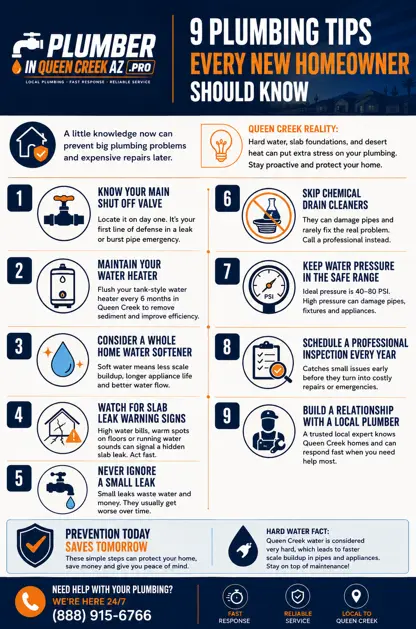
1. Learn where your main shut-off valve is, and use it fast when needed. Nothing limits water damage better than shutting the supply off the moment you spot trouble. A slab leak or a burst pipe can dump hundreds of gallons in a matter of minutes.
2. Stay ahead of your water heater’s maintenance. Manufacturers and the Department of Energy both point to an annual flush as the baseline for tank-style units. Given the water here, cut that down to every six months instead.
3. Look into a whole home water softener. Treating the water before it reaches your pipes and appliances slows down scale buildup and buys your water heater extra years of life.
4. Take slab leak warning signs seriously. A water bill that jumps for no reason, a warm patch on the floor, or the sound of running water with everything shut off all point toward a leak under the foundation. Get a plumber out right away if you notice any of it.
5. Don’t put off fixing a small leak. A dripping faucet or a toilet that runs slow wastes water around the clock, and it usually means a part has worn out that only gets pricier to replace the longer you wait.
6. Leave the chemical drain cleaners on the shelf. They tend to eat away at older pipes without actually clearing what’s causing the clog. A professional drain cleaning handles the real problem without that risk.
7. Know what normal water pressure feels like. Anything above 80 psi starts to wear on pipes, water heaters, and fixture connections. The International Plumbing Code actually requires a pressure-reducing valve once incoming pressure crosses that mark.
8. Get a professional inspection once a year. A licensed plumber catches early corrosion, worn valves, and slab leak signs long before they turn into a Saturday night emergency.
9. Find a plumber you trust before you actually need one. Having that number saved already saves precious time once something does go wrong.
7 Common Plumbing Problems in Queen Creek Homes
| Problem | Likely Cause | What To Do |
| White scale on fixtures | Hard water mineral buildup | Install a water softener |
| Water heater sediment | Mineral deposits settling in the tank | Flush the tank every 6 to 12 months |
| Slow or clogged drains | Grease, hair, or soap buildup | Book professional drain cleaning |
| Warm floor spots or high water bill | Slab leak | Call a plumber for leak detection |
| Running toilet | Worn flapper or fill valve | Replace the part or call a plumber |
| Weak water pressure | Clogged aerators or a failing regulator | Test pressure and inspect the regulator |
| Sewer backup | Tree roots or line blockage | Schedule hydro jetting or sewer inspection |
Seasonal Plumbing Maintenance Calendar
| Season | Recommended Tasks |
| Spring | Inspect irrigation lines, check outdoor hose bibs, test sump areas |
| Summer | Monitor water pressure during peak use, watch for AC condensate line clogs |
| Fall | Flush the water heater, inspect exposed pipes before cooler nights |
| Winter | Disconnect hoses on freezing nights, check pipe insulation in the garage |
4 Steps to Prepare for a Plumbing Emergency
Know these moves before you’re ever standing in an inch of water at midnight.
1. Shut the main valve off right away if you spot a burst pipe or a major leak.
2. Call an emergency plumber immediately for sewage backups, no hot water, or active flooding.
3. Keep a wrench near the main shut-off valve, so you’re never hunting for one mid-crisis
4. Cut power or gas to the water heater if the tank itself is leaking.
Dealing with a plumbing emergency right now? PlumberinQueenCreekAZ offers same-day scheduling and a written price before work starts. Call (888) 915-6766.
Professional Standards That Protect Queen Creek Homeowners
Arizona law requires a license from the Arizona Registrar of Contractors for any plumbing job worth more than $1,000, materials included. Plumbers need a C-37 or R-37 classification to take on that work legally, and going with someone unlicensed strips away your legal protection if the job goes sideways. Ask for the ROC license number up front, every time.
Plumbing work nationwide generally follows the Uniform Plumbing Code set by the International Association of Plumbing and Mechanical Officials, and fixture efficiency follows the EPA WaterSense program, which limits toilets to 1.28 gallons per flush and showerheads to 2.0 gallons per minute.
Our team at PlumberinQueenCreekAZ has spent 17 years working on homes across Queen Creek and the East Valley. [NEEDS TECHNICIAN OR OWNER NAME AND ROC LICENSE NUMBER to publish]. Every job we do carries a one-year workmanship warranty, and we offer same-day scheduling when the timing matters.
Serving New Homeowners Across Queen Creek
We cover neighborhoods throughout Queen Creek, including Barney Farms, Meridian, Ironwood Crossing, Hastings Farms, Cortina, Harvest Queen Creek, and the Villages at Queen Creek. Our team also serves San Tan Valley, Gilbert, Chandler, Mesa, and Florence, across ZIP codes 85140, 85142, and 85143.
6 Frequently Asked Questions
What should I inspect first after buying a home in Queen Creek?
Start with the main water shut off valve. From there, check under every sink, run every toilet, and take a look at the water heater. These few checks catch problems that already existed before they turn into an emergency during your first month.
How does hard water affect plumbing in Queen Creek?
Hard water leaves mineral scale coating the inside of pipes, water heaters, and fixtures over time. That buildup slows water flow, shortens how long appliances last, and raises the odds of a clog. A whole home softener slows that damage down considerably.
How often should I flush my water heater?
Once a year is the bare minimum for a tank-style unit. Given the water quality around Queen Creek, flushing every six months keeps sediment from cutting the heater’s lifespan short.
What are the warning signs of a slab leak?
Watch for a water bill that spikes without explanation, warm spots on the floor, dropping pressure, or running water sounds when every fixture is off—any of these calls for a licensed plumber right away.
When should I call an emergency plumber instead of waiting?
Call right away for active flooding, sewage backing up, no hot water during a cold snap, or a burst pipe. Shut off the main valve first, then get a licensed local plumber on the phone.
Should I install a water softener in my new home?
Given how hard the water runs around here, most Queen Creek homes come out ahead with one installed. It protects the water heater, extends fixture life, and keeps scale buildup in check throughout the system.
Protect Your Plumbing From Day One
The first month in a new house sets the tone for everything after it. A short inspection now beats an expensive repair later.
Book your whole home plumbing inspection with PlumberinQueenCreekAZ today. Call +1 (888) 915-6766 or stop by 21838 S Ellsworth Rd, Queen Creek, AZ 85142. Same-day scheduling, a written price up front, and a one-year workmanship warranty on every job.