Water Heater Repair Cost in Queen Creek, AZ (2026 Homeowner Pricing Guide)
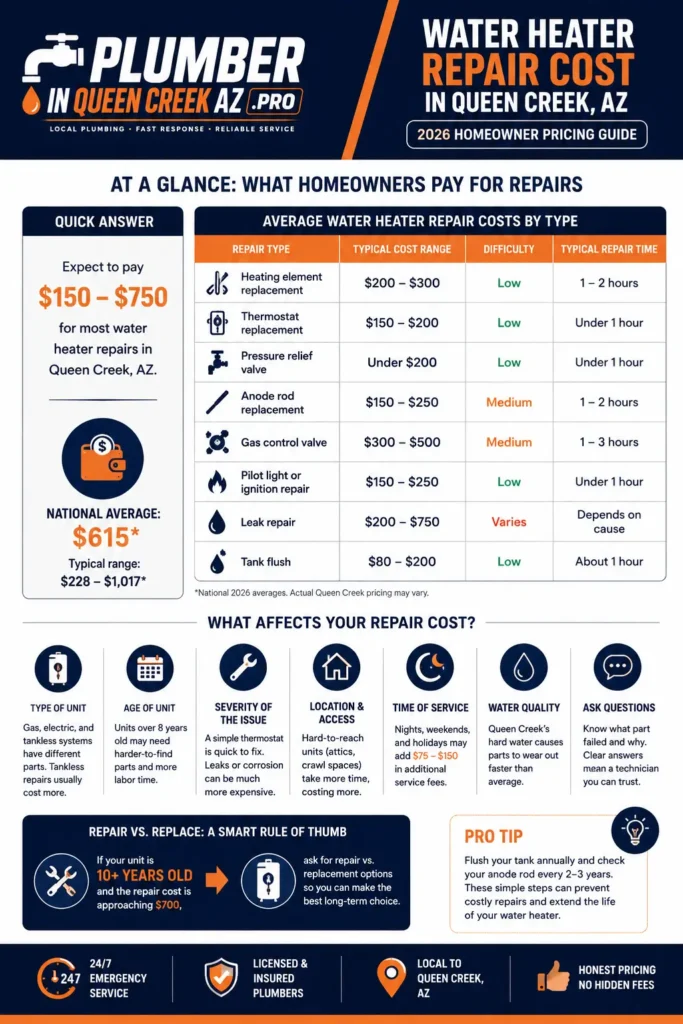
Expect somewhere between $150 and $750 for a typical repair job in Queen Creek. A thermostat swap sits at the low end. Chase down a leak or replace a gas control valve, and the bill climbs higher.

Nationally, homeowners land around $615 on average, with most jobs falling somewhere in the $228 to $1,017 window once you factor in parts and labor. One thing worth doing before you approve any invoice: if your unit has already passed the 10-year mark and the quote is pushing toward $700, ask the technician to walk you through repair versus replacement math side by side.
Get a written repair estimate from best water heater repair company of Queen Creek before any work starts.
Average water heater repair costs in Queen Creek
Below is what homeowners generally pay by repair type. Treat these as planning numbers pulled from 2026 national repair data, not a quote. Your technician can confirm exact Queen Creek pricing once they’ve looked at the unit.
| Repair Type | Typical Cost Range | Difficulty | Typical Repair Time |
| Heating element replacement | $200 to $300 | Low | 1 to 2 hours |
| Thermostat replacement | $150 to $200 | Low | Under 1 hour |
| Pressure relief valve | Under $200 | Low | Under 1 hour |
| Anode rod replacement | $150 to $250 | Medium | 1 to 2 hours |
| Gas control valve | $300 to $500 | Medium | 1 to 3 hours |
| Pilot light or ignition repair | $150 to $250 | Low | Under 1 hour |
| Leak repair | $200 to $750 | Varies | Depends on cause |
| Tank flush | $80 to $200 | Low | About 1 hour |
Rust-tinted water is usually the anode rod giving out, and catching that early keeps the fix in the $150 to $250 range. Wait too long, and you’re not looking at a repair anymore. Once the tank shell itself has failed, replacement is the only real option.
Small parts break. Tanks corrode. Those are two very different bills.
What affects water heater repair costs?
A quote isn’t just one number pulled out of thin air. A handful of things push it up or down.
- The type of unit you own. Gas, electric, and tankless systems don’t share parts, and tankless repairs tend to run higher since the components cost more and fewer techs work on them regularly.
- Its age. Once a water heater crosses the eight-year mark, sourcing parts can take longer, and that extra time shows up in the labor charge.
- How bad the problem actually is. A blown thermostat is a quick fix. Water damage from a slow leak, or early tank corrosion, is a different conversation entirely.
- Where the unit sits: a water heater tucked in a cramped attic takes longer to reach than one sitting in an open garage closet, and access time gets billed.
- When you call, nights and weekends usually tack on another $75 to $150 in service fees.
- Your water itself. Queen Creek’s mineral-heavy supply wears parts down faster than average, which we’ll get into below.
Ask what part failed and why before you sign off on a repair. A technician who can explain it clearly is usually one worth trusting.
Most common water heater repairs
Heating element and thermostat issues
Electric units run into this most. Water that never quite gets hot, or stays lukewarm no matter how long you wait, usually traces back to one of these two parts. Both are cheap and quick to swap out, which makes this one of the more painless repairs on the list.
Pilot light and gas valve problems
A gas unit that won’t stay lit, or one that carries even a faint gas smell, needs a professional look right away. This isn’t a weekend project. Gas valve work belongs to a licensed technician, full stop.
Pressure relief valve failure
This valve exists to release pressure before it becomes a problem for the whole tank. If yours won’t stop dripping or has already started leaking, get it replaced quickly rather than waiting it out.
Anode rod wear
Think of the anode rod as a sacrificial part. It draws corrosive minerals away from your tank so the tank doesn’t take the hit. Queen Creek’s hard water eats through these faster than the national average, so check yours every two to three years instead of waiting for a problem.
Sediment buildup
That rumbling or popping sound your tank makes isn’t normal. It’s mineral sediment settling at the bottom. A flush clears it out, restores efficiency, and can buy your unit extra years of life.
Leaks
Some leaks are nothing more than a loose fitting, an easy and inexpensive fix. Others come from a cracked tank, which no amount of tightening will solve. A technician needs eyes on it before anyone can quote a fair price.
Catch most of these early, and you’re usually under $300. Let them sit, and the number only goes up.
Repair or replace: which saves more money?
| Repair | Replacement |
| Lower upfront cost | Higher upfront investment |
| Best for units under 8 years old | Better for units past 10 to 12 years |
| Fixes a single failed part | Needed for tank corrosion or repeated failures |
| Makes sense under warranty | Makes sense with frequent breakdowns |
There’s a rule of thumb plumbers lean on here: once a repair quote reaches roughly half the price of a new installed unit, replacement usually wins out financially. A full replacement typically lands between $900 and $5,500 depending on the unit, though most homeowners end up paying $1,200 to $2,500 for a standard 40 or 50 gallon tank system.
Do that math before you decide anything. It’s a five-minute calculation that can save you from throwing good money after a dying unit.
Water heater problems that need immediate attention
Some issues can wait for a scheduled visit. These can’t:
- A leaking tank, or standing water pooling at the base
- No hot water anywhere in the house
- Water running rusty or discolored
- Any gas smell near the unit
- Loud banging, popping, or rumbling from inside the tank
- Water actively discharging from the pressure relief valve
- A pilot light that keeps going out
None of these get better on their own. Call sooner rather than later.
How Queen Creek’s hard water increases repair costs
Queen Creek’s water sits between 6 and 17 grains per gallon, which the Town itself classifies as moderately hard to very hard. It all comes from groundwater pumped through local wells, and that mineral load doesn’t stay in the pipes. It builds up inside water heater tanks too.
Three things follow from this: anode rods wear out faster, tanks need flushing more often than the standard once-a-year advice, and heating efficiency drops, which quietly pushes your energy bill up over time.
If you’re flushing sediment more than once a year, or your water heater keeps failing ahead of schedule, a whole home water softener is often the fix that actually addresses the cause instead of the symptom.
How to reduce water heater repair costs
- Flush the tank every year. This one habit prevents most sediment-related failures before they start.
- Install a water softener. It tackles Queen Creek’s hard water at the source instead of just treating the fallout.
- Check the anode rod every two to three years. Replacing it early costs far less than replacing the whole tank later.
- Get a yearly inspection. Small issues caught early stay small.
- Keep an eye on water pressure. High pressure puts constant strain on the tank, valves, and fittings.
- Don’t ignore small leaks. A $150 valve fix today beats a $2,000 replacement six months from now.
Water heater maintenance schedule
| Task | Frequency |
| Flush tank | Annually |
| Inspect pressure relief valve | Annually |
| Check anode rod | Every 2 to 3 years |
| Inspect for leaks | Monthly |
| Professional inspection | Annually |
Serving Queen Creek and the East Valley
Plumber in Queen Creek AZ repairs water heaters throughout Queen Creek, including Barney Farms, Meridian, Ironwood Crossing, Hastings Farms, Cortina, and Harvest Queen Creek. Coverage extends out to San Tan Valley, Gilbert, Chandler, Mesa, and Florence, spanning ZIP codes 85140, 85142, 85143.
Behind every repair is 17 years of hands-on plumbing experience. Every job comes with same-day scheduling, a written price before any work begins, and a one-year workmanship warranty backing it up.
Frequently asked questions
How much does water heater repair cost in Queen Creek?
Plan on somewhere between $150 and $750 depending on what’s actually broken. A thermostat replacement sits near the bottom. Leak tracing and gas valve repairs push toward the top. Get everything in writing before work starts.
Is it cheaper to repair or replace a water heater?
Repair usually wins for units under 8 years old with one failed part. Once repair costs creep toward half the price of a new installed unit, or the tank itself has corroded, replacement becomes the smarter move.
How long does a water heater last in Queen Creek?
Tank units typically run 8 to 12 years. Tankless units often stretch to 15 or 20 years with regular maintenance. Queen Creek’s hard water can shorten both ranges if the unit isn’t flushed and checked on schedule.
Does hard water increase repair costs in Queen Creek?
Yes. Water here measures 6 to 17 grains per gallon, landing in the moderately hard to very hard range. That mineral content speeds up sediment buildup and anode rod corrosion, which means more repairs over the life of the unit.
How often should I flush my water heater?
Once a year covers most homes. If your water is on the harder end or you don’t run a softener, flushing more often helps head off sediment-related breakdowns.
Can I repair a leaking water heater myself?
A loose fitting is sometimes a simple fix. A leak coming from the tank itself isn’t repairable and means the unit is done. A professional inspection confirms which one you’re dealing with before you spend money in the wrong place.
Need a water heater repair estimate?
Call (888) 915-6766 or request a written estimate online. Same-day scheduling is available across Queen Creek and the East Valley.